
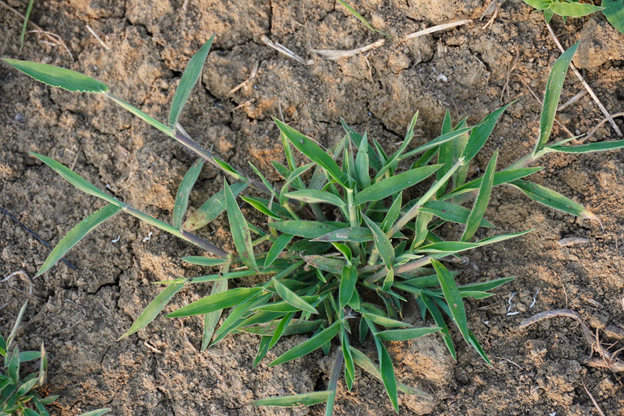
It won’t be long now before homeowners around the country are starting to wake up to the warmer temperatures and giving their landscape maintenance, specifically lawn maintenance, serious thought.
As in so many other areas in life, being prepared ahead of the game is a precursor to success. The same goes for lawn care, and one of the contingencies you have to prepare for is the manifestation of specific, prolific weeds like crabgrass.
This article will cover just that; the problem of crabgrass and how to get control of it.
What Is Crabgrass, and Why Is It a Problem?
Crabgrass is a noxious weed that infiltrates turf and lawns and often thrives despite intense heat and drought conditions. They are also tolerant of other adverse conditions, making the weed even more difficult to deal with.
Crabgrass typically germinates from a seed, but it can also spread from root nodes, and forms large, thick, unsightly patches in lawns. It can form thick clumps and individual plants can grow together, and it is a low-growing grass that produces fingerlike stalks or branches, out of which the leaves grow.
The fact that it is unsightly is problem enough, but being as prolific as it is, as well as tolerant of inhospitable conditions, crabgrass can easily choke out a lawn in a single season. Moreover, it cannot be controlled by mowing alone, as even when moved as low as ½”, it will still produce and propagate seeds.
Paired with the fact that crabgrass spreads rapidly and can crowd out the grass in your lawn, it also steals moisture and nutrients, competing much more effectively than most other grasses can. Therefore, it behooves homeowners to have a plan to deal with this pesky weed, not just where it appears, but before it appears.
The Importance of Crabgrass Pre-Emergent Treatment in Landscape Maintenance
Spot-treating clumps of crabgrass can not only be effective, but it is also necessary in situations in which the weeds gain a foothold during the summer. However, an effective crabgrass management strategy starts long before that, with a crabgrass pre-emergent treatment.
Because of their rapid growth and fertility, dealing with weeds like crabgrass with a crabgrass pre-emergent is one of the most effective ways to nip the issue in the bud; in fact, it nips the issue before it buds.
This crabgrass pre-emergent treatment doesn’t kill crabgrass like a spray. It prevents the crabgrass from growing at the cellular level. Basically, Prodiamine stops the cells from dividing during germination; the plant can’t grow, so effectively, it never even sprouts. It solves the problem before it’s even a problem at all.
And, the best part about this treatment is that it is not just for crabgrass. It is also effective against other troublesome weeds like goosegrass, chickweed, spurge, and many other broadleaf weeds. So, by treating your lawn or turf with this crabgrass pre-emergent, you’ll be better equipped to deal with many other weeds throughout the summer.
Ongoing Treatment Through the Summer
Even though our crabgrass pre-emergent treatment is highly effective at preventing the growth of common weeds such as crabgrass, our landscape maintenance services are prepared for contingencies.
The second round of our turf fertilization and weed control program involves spraying the entire strand of turf on the property. This almost completely eliminates any broadleaf weeds that may have popped up during this time and the second round is usually administered between May and June.
By the middle of the summer, most weeds will have been either prevented or killed through spraying during the second round of treatment, but all the same, in the middle of the summer (the end of June through the beginning of August) we spot-treat for any crabgrass or other weeds that were not prevented by the pre-emergent or killed by previous spraying.
This protocol, which also accounts for fertilization and grub control, is highly effective at preventing the proliferation of common weeds like crabgrass.
Preparing for Next Season in the Fall
Even after the end of the summer, weed control isn’t over. At the end of the summer, from August to September, we continue spot treatment for any crabgrass or other weeds that may have cropped up, and in the early fall (September through early November) we continue weed control efforts.
These involve applying appropriate herbicides so that weeds, which will continue to absorb nutrients through their taproots, will absorb the treatment, killing them before the next season.
This step is important as it is crucial for homeowners to remember that spot treatment in the warmer parts of the year is only one small element of controlling weeds on your property. Prevention, including treatment at the end of the summer to prevent weed growth the following year, is just as important.
Contact Us for Crabgrass Control and Landscape Maintenance Services
Even though crabgrass is a common problem, you can get ahead of it with appropriate landscape maintenance and turf maintenance programs.
Our weed control protocols are part of larger maintenance programs that include spot treatment, as well as grub control (for turf) and fertilization, all of which result in optimal turf health.
We serve both residential and commercial properties, so if you have any questions about our processes, would like a quote, or want to schedule a consultation, contact us and we will be more than happy to help you get that pain in the grass under control!